What Solutions Engineering Actually Means
If you’re outside the data center world, “Head of Solutions Engineering” can sound like one of those titles that means everything and nothing. In practice, it’s a very specific job: making sure what gets sold can actually be delivered and that what gets built will still work when a customer moves in.
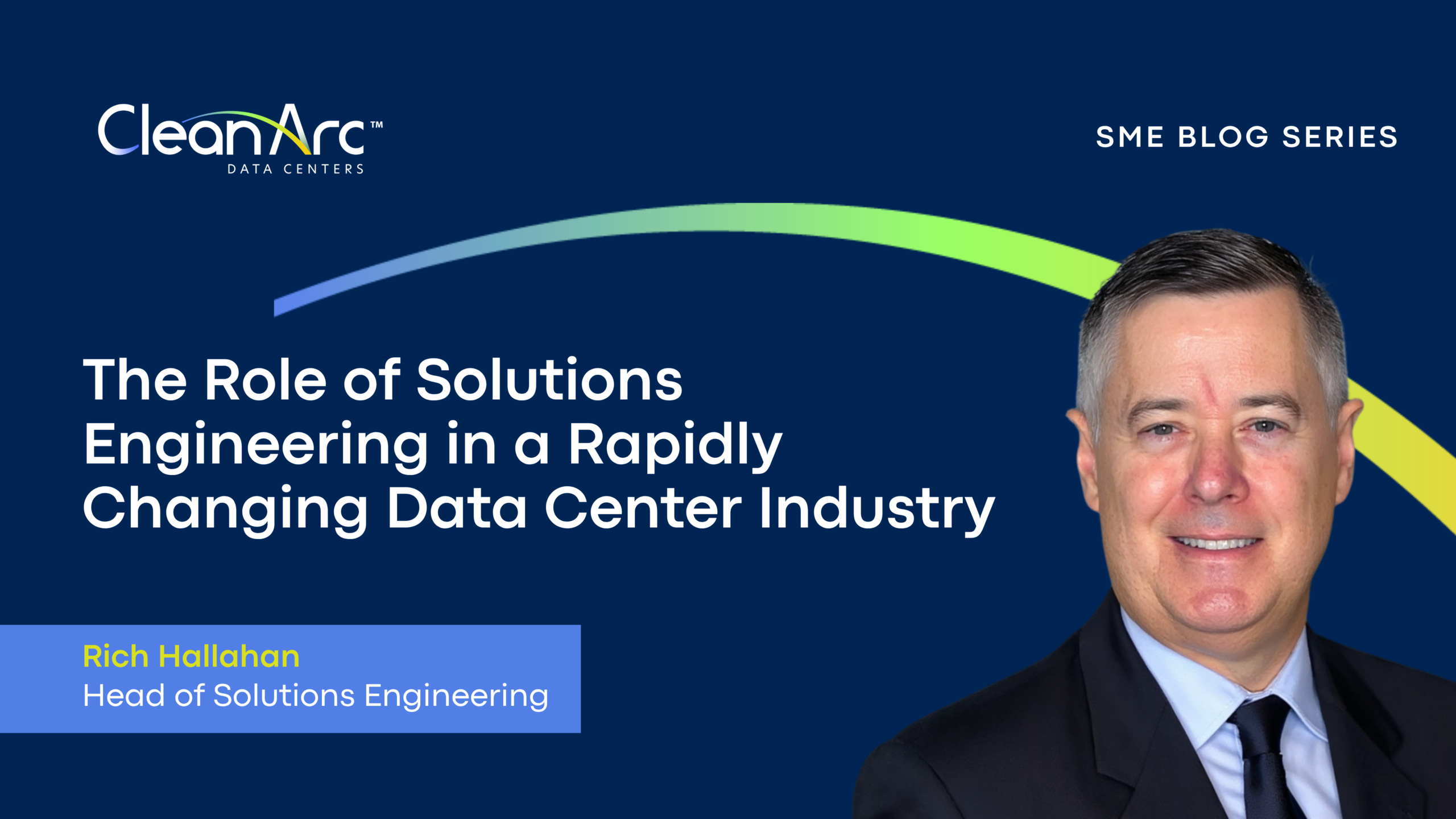
Rich Hallahan sits at the intersection of sales, engineering, and the end customer. Data center deployments are highly technical, and customers rarely arrive with requirements that fit neatly into a template. Rich works closely with the sales team to understand what a customer is trying to achieve, then translates those needs into something the technical team can validate, design, and ultimately build.
The role extends beyond answering technical questions in the moment. A key part of solutions engineering is tracking where the market is heading and feeding those insights back into the product. As infrastructure equipment evolves and customer expectations shift, Rich acts as a conduit between manufacturers, vendors, customers, and internal teams.
As he puts it, he is often the “glue” between the moving parts, connecting the right people and aligning technical and commercial priorities so the end result works for both the customer and the business.
Designing for a Moving Target
Once a customer engagement moves from conversation to planning, the real work begins. Hyperscalers and enterprise tenants often arrive with a deployment vision, but translating that into a physical environment requires validation, adjustment, and collaboration.
In some cases, customers come with highly detailed specifications for pod layouts, rack configurations, or aisle spacing. Rich’s role is to determine how those requirements fit within the physical constraints of the facility. Using layout modeling and design tools, he evaluates whether the deployment works within the available space, accounting for factors such as column placement, row length, and supporting infrastructure.
Other times, the process is more exploratory. Customers may share general workload goals or density targets without a finalized deployment plan. That’s where the back-and-forth begins. Rich works with them to refine layouts and suggest adjustments that improve operational flexibility or efficiency once the facility is live.
The timeline adds another layer of complexity. Data center capacity is often leased years before equipment is installed, meaning infrastructure designed today must support technology that may evolve significantly before deployment.
As Rich explains, “What the customer thinks will go in there today may change six times before it actually shows up.”
Rather than locking every detail into place immediately, the focus is on designing environments flexible enough to adapt as requirements shift.
The Density Question
If there is one technical conversation dominating the data center industry today, it is power density. AI workloads have dramatically increased the amount of power required inside a single cabinet. Where traditional enterprise deployments once operated at relatively modest densities, modern AI infrastructure is pushing those limits higher with each hardware generation.
Companies like Nvidia have effectively set the pace for this shift. Current AI cabinets can exceed 100 kilowatts, and roadmaps suggest that even higher-density systems could arrive in the near future. Cabinets requiring several hundred kilowatts are already part of industry discussions. For infrastructure teams, the challenge is determining how quickly those projections will translate into real deployments.
“There’s always an adoption curve,” Rich explains. New hardware may define what is technically possible, but manufacturing capacity, cost considerations, and operational realities often determine how quickly those systems become widespread.
In the meantime, facilities must support a range of deployments, from traditional workloads to emerging AI clusters. Rather than chasing every headline about the next breakthrough system, solutions engineering focuses on understanding where the technology is likely to land and ensuring the infrastructure can evolve alongside it.
The Physical Limits of Infrastructure
As computing density increases, the conversation around data center design is also shifting toward physical constraints. Over the past decade, facilities have become more efficient. Layouts have been optimized and building footprints compressed to support more computing power within smaller spaces. But that trend may be approaching its practical limits.
“What we’re starting to see,” Rich explains, “is the building itself becoming a smaller part of the overall equation.”
While the facility footprint has tightened, the infrastructure required to support modern computing environments has expanded. Power distribution systems, cooling infrastructure, and supporting equipment are all growing in scale as rack densities increase and workloads become more demanding. At a certain point, reducing the size of the building further no longer creates meaningful savings. Compared with the specialized infrastructure required inside, the physical structure itself becomes a relatively small portion of the overall project.
That shift is prompting new discussions across the industry, from rethinking redundancy strategies to exploring ways to simplify infrastructure systems while maintaining reliability. For solutions engineers, it reinforces a simple reality: data center design must continuously evolve alongside the technology it supports.
The Geography of Data Centers Is Changing
For years, the data center industry has concentrated around a handful of established markets. Locations like Northern Virginia became dominant because they offered strong connectivity, infrastructure, and proximity to major population centers. But as demand accelerates and power constraints tighten, those dynamics are beginning to shift.
Developers are increasingly exploring locations just outside traditional Tier 1 markets, where power availability, land access, and infrastructure flexibility may be easier to secure. The challenge is maintaining the connectivity and latency performance customers expect while expanding beyond the most congested hubs.
That balance is what CleanArc describes as Tier One Adjacent.
The concept focuses on sites located just outside traditional hyperscale corridors. These locations offer greater flexibility for land acquisition and infrastructure development while remaining close enough to major network hubs to support modern workloads.
In many cases, they also provide opportunities to take advantage of underutilized power infrastructure or explore on-site energy solutions, while still maintaining the connectivity needed for latency-sensitive applications such as AI inference and large-scale digital services.
A Small Industry with a Long Memory
Despite the scale of modern data center development, the industry itself remains surprisingly interconnected. After more than two decades working across different parts of the sector, Rich has seen firsthand how relationships shape the way projects move forward. Even as the industry grows, the degrees of separation between professionals remain small.
“You start to realize how few degrees of separation there really are,” he says.
That reality places a premium on trust and reputation. Engineers, developers, operators, and vendors often cross paths repeatedly throughout their careers, and the way people collaborate today can influence opportunities years down the line.
Technical expertise will always matter in a field as complex as digital infrastructure. But as Rich sees it, success in the industry often comes down to something more fundamental: building relationships, communicating clearly, and earning the trust of the people you work with.
In an industry where projects last decades and reputations travel quickly, those connections remain one of the most important pieces of infrastructure of all.